Thursday, 12 November 2026

From Wall Hanging to Blanket - an Echo Special

My new book MAXIMALIST MOSAIC CROCHET has lots of beautiful new patterns in it. But the book fun doesn't end there, because I'm going to be sharing some of my favourite restyles here, to inspire you to try more ways to enjoy the designs! Most of the 16 patterns in the book can be resized, as they follow a simple starting chain multiple. That means we can turn wall hangings into blankets, blankets into bags, bags into table runners... it's all possible with a little imagination!


The book is all about giving yourself permission to go bold with the colour, getting those dopamine hits going, so get creative with your yarn and have some fun experimenting!


So, first up, here's my Echo Wall Hanging from the book - it's a beautiful piece of artwork, framed by these popping acidic yellow dowels. 


I love the balance and simplicity of this design, so I decided to transform it into a blanket. One little post on Instagram later and I realised how much you all loved the blanket version, so here's my Echoes Blanket!


...And here's how to make it:

You will need:

The Echo Wall Hanging pattern from my book MAXIMALIST MOSAIC CROCHET

Yarn:

I used Colour Crafter (a dk/light worsted yarn) by Scheepjes in the following shades:
Yarn A: Hasselt (2010) 3 balls (I've allowed an extra ball here as it was VERY close to 200g! You might want to edge the long sides too.)
Yarn B: Nijmegen (1712) 3 balls
Yarn C: Arnhem (1027) 2 balls
Yarn D: Mechelen (2013) 2 balls
Yarn E: Wolvega (1099) 1 ball

(But you can of course use any yarn as this pattern is SO adaptable. Just remember your quantities might not be the same as mine if you switch yarn type/brand. Also, you can make the blanket larger/smaller to suit you, using the starting chain repeat multiple given below - this will obviously impact yarn quantities too.)

A 5.5mm (I-9) crochet hook

Finished size: Approximately 100 x 145cm (39 x 57in) 

Gauge/Tension: 10 x 10cm measures 16 stitches by 19 rows

Method:
You are going to follow the basic Echo Wall Hanging instructions from the book, using Yarns A-E exactly as listed in the pattern.

The pattern works to a starting chain repeat multiple of (x 9) + 7, so to make this blanket to the approximate size listed above, start with ch160 using Yarn A. You will have 159 stitches at the end of Row 1.

Now follow the pattern as set, up to and including Row 158. Do not fasten off at the end of Row 158, keep Yarn A attached, switch to Yarn B then repeat Rows 13-158 as set once again to make the second 'echo' pattern.


To finish, fasten off and weave in all your ends. The original Echo Wall Hanging has edging and hanging tabs added, so if you wanted to add some edging along the 'raw' long edges of your blanket, I suggest you use Yarn A and follow Rows 1-2 of the Edging instructions. 

OK, hope you enjoy this reworking of the Echo pattern, let me know how you get on, and don't forget to have FUN with your colours!

Esme xx


New book has landed! Maximalist Mosaic Crochet is here!


Well well well, it turns out I simply cannot stop writing crochet books! I'm very excited to announce to you all that my third book has just been published! Published by the brilliant David And Charles Publishing.


Pretty, isn't it?? It's called MAXIMALIST MOSAIC CROCHET, and it contains 16 colourful dopamine popping joyful designs for you and your home! Ditch the beige and enter a world of maximalist fun - think neon pops, bold patterns and my usual geometric obsessiveness. 

So, what will you find inside? Well, there's a wide range of gorgeous things to make - everything from throws and lampshades to bags, cushions, shawls, rugs, wall hangings and place mats, all made using the inset mosaic crochet technique. Here's a taster:


 Road to Anywhere Shawl


Blue Lotus Throw


Add It Up Cushions


Leafage Wrap


 Wordy Cushion Trio


Anni Floor Pouffe


There's a full step-by-step tutorial at the start of the book if this is a new technique for you - once you've got that down you'll be able to tackle any project.

In addition, over the next few weeks I'll be showing you how to rework some of some of these patterns, so that you're inspired enough to go your own maximalist way and embrace these designs to make them your own.

As always, thank you so much for joining me in my world of crochet.

Last but not least, many thanks to the people behind the scenes:

David And Charles Publishing for producing such a gorgeous book

Scheepjes and Wool Warehouse for their generous yarn support

My amazing testers Halyna and Nano for all their help


Esme xx 


Monday, 12 February 2024

We must be crazy... but it's our 12 hour CROCHET-A-THON fundraising event!!!!


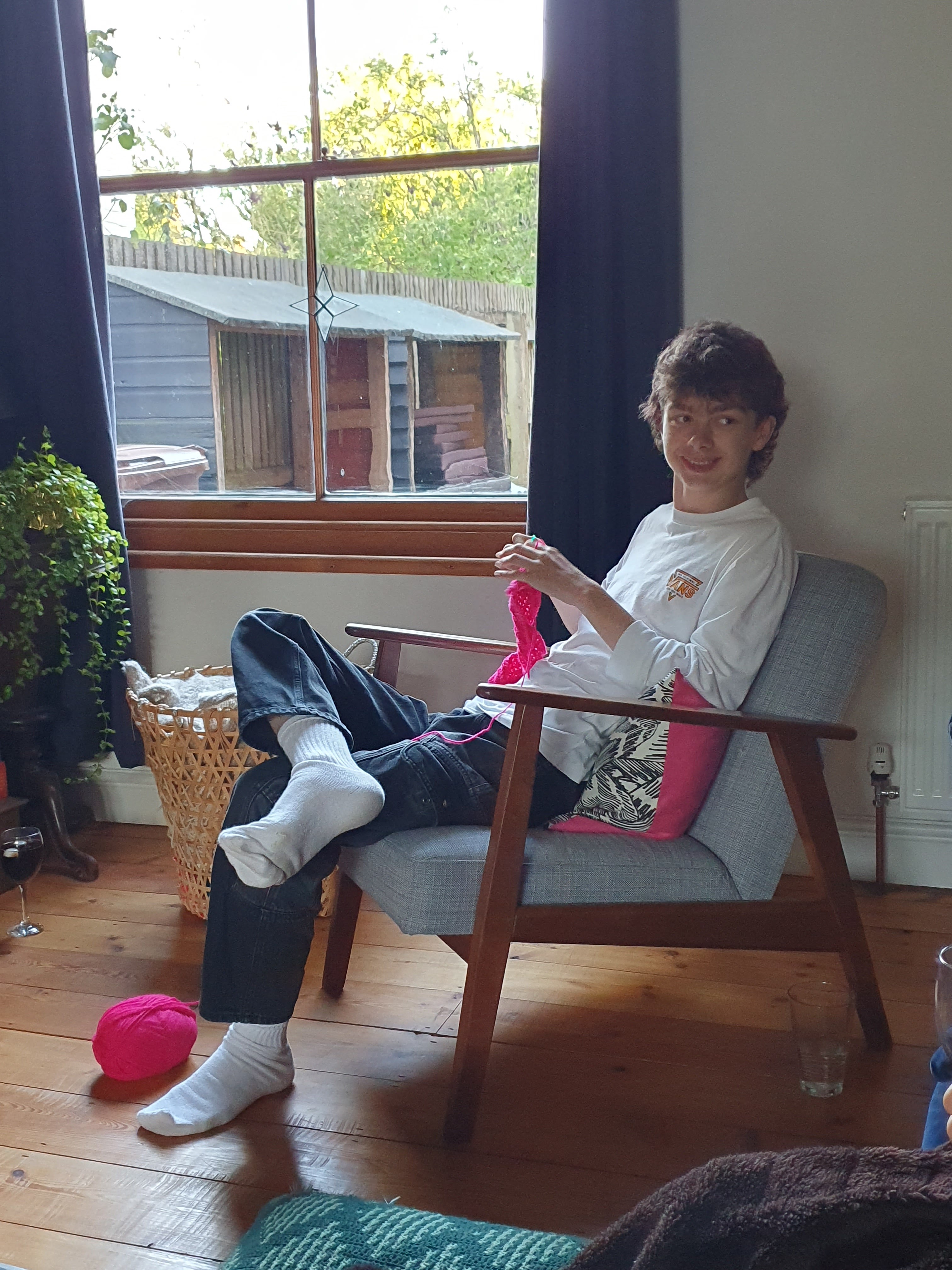
Meet my son Walt! Crochet dude! Fundraiser extraordinaire!

Well, this is so exciting! My 17 year old son Walt has been lucky enough to be offered a place on a biodiversity and conservation field trip to South Africa with Operation Wallacea as part of his biology studies at college this summer! So, we are going into full-on fundraising mode to help him pay for this incredible opportunity, as it is 100% self-funded (yes, it’s verrrrrry expensive)! And this is where me and my crochet skills come in! Walt and I are planning a...


12 hour Non Stop Crochet-A-Thon, 8am to 8pm on Saturday 17 February!


That's right! 12 hours of NON STOP CROCHET - the lad can crochet pretty well so we are going to go for it and crochet non-stop to raise funds for his trip! If you would like to support Walt and keep his hook hooking (and mine for that matter!) for 12 hours we would be so happy and grateful. You can find out more about Walt and his field trip with Operation Wallacea (including how to make a small donation to the fund) HERE


Who is Operation Wallacea?

Operation Wallacea is a network of academics from European and North American universities, who design and implement biodiversity and conservation management research expeditions. Since their inception, they have identified hundreds of new species of birds, amphibians, reptiles and mammals, and have to date published over 640 research papers. They are an extremely well-respected international non-profit organisation. You can read more about them HERE


What will we be doing on the day?

Well, in a nutshell, Walt and I will be crocheting alllllllll day long! I will be making a NEW Seed Pod Throw blanket design:


and... excitingly... this pattern will be available FOR FREE here on my Blog from 8am to 8pm GMT on Saturday 17 February if you want to grab a screenshot of it. Walt will be making a poncho for himself in lovely earthy colours, perfect to take with him on his expedition to South Africa in July- I hear it gets chilly at night so a cosy crocheted poncho will keep him warm!


Friday, 1 December 2023

CRUNCH STITCH SHAWL - A FREE PATTERN!

Hello there, dear crochet fans!

Another day, another free pattern. I know.  You're welcome. I'm on a roll!

Introducing: the Crunch Stitch Shawl! 


This is a rather lovely shawl to make for several reasons. Firstly, it's an absolute corker of a stash buster, as you can use any colours, go super-stripey, or 2-tone, or however you feel... dive into that yarn stash! Secondly, it's a very easy pattern - it's basically a simple single row repeat. Thirdly... well, what a great Christmas gift for a loved one! It's a beautiful warm and cosy shawl, which you can make to any size to suit. A little version for a child, or just keep adding rows and go super-large for anyone who loves wrapping up big time for winter walks! Bobble edging or no bobble edging... but you know me... I'm Team Bobble every time!


The stitch used, the crunch stitch, is probably in my top 3 stitches of 2023, I'm obsessed - it was one of 100 patterns featured in my recent book Mix and Match Modern Crochet Blankets, available to buy from all decent booksellers if you want to explore more new stitches!


So, without further ado, here's the free Crunch Stitch Shawl pattern for you. Enjoy it! You can use this pattern, share it, even make shawls and sell them, but please always give me credit as the designer, and don't be a numpty and pass this pattern off as your own! Respect, peace and love!


YOU WILL NEED

Hook: a 6.5mm crochet hook

Yarn: Any dk/light worsted yarn of your choice 

I used the following:

Scheepjes Colour Crafter

Yarn A: Nijmegen (approx 80g)

Yarn B: Verviers (approx 24g)

Yarn C: Rotterdam (approx 12g + 20g for edging)

Yarn D: Hilversum (approx 12g)

Yarn E: Wolvega (approx 12g)


ABBREVIATIONS (UK terms):

ch: chain

dc: double crochet (US single crochet)

htr: half treble crochet (US half double crochet)

lp(s): loop(s)

rep: repeat

RS: right side

ss: slip stitch

st(s): stitch(es)

WS: wrong side

yoh: yarn over hook


Colour stripe pattern as follows (with number of rows worked in each colour, e.g. 8A means 8 rows in Yarn A):

(8A, 2B, 2C, 2D, 2C, 2B, 8A, 2E, 2B, 2D, 2B, 2E) twice, then 10A to finish.


SPECIAL STITCHES

Bobble: Ch3, work the following in the first ch made: (yoh, insert hook in ch, yoh, pull up lp, yoh, draw through first 2 lps on hook) 3 times, yoh, draw through all lps on hook, ch1, ss in same first ch made.

How to change colour: Work the last dc of the row up to the final 2 loops on the hook, yoh with the new colour, draw through new colour to finish stitch. Fasten off old colour. I like to knot the old and new colours together for security, before weaving in ends. 


MEASUREMENTS (including bobble edging) 

Width from top corner to top corner: 130cm

Length from top middle to bottom point: 46cm


Keep ALL stitches fairly loose, especially the slip stitches, to make sure you can insert the hook easily on following rows.


INSTRUCTIONS

With Yarn A, ch2.

Row 1 (RS): 3dc in first ch made, turn.

Row 2 (WS): Ch1 (does not count as st throughout), (1dc, 1htr) in first st, ss in next st, (1htr, 1dc) in last st, turn.

Row 3: Ch1, (1dc, 1htr in first st), 1ss in next st, 1htr in next st, 1ss in next st, (1htr, 1dc) in last st, turn.

Row 4: Ch1, (1dc, 1htr in first st), 1ss in next st, *1htr in next st, 1ss in next st; rep from * to last st, (1htr, 1dc) in last st, turn.

Row 5 onwards: Rep Row 4, following colour stripe pattern (see above). See Special Stitches for colour change technique.

Fasten off and weave in all ends.


EDGING

Using Yarn C and with WS facing, join yarn with ss in ch at bottom point, *make bobble (see Special Stitches), 1dc in each of next 4 row ends up towards top corner; rep from * to top corner, adjusting bobble placement as necessary so that you make a bobble in the top corner st.

Work along top edge as follows: *1dc in each of next 5 sts, make bobble; rep from * to end of top edge, adjusting bobble placement as before so that you make a bobble in the next top corner st.

Work down final side as you did for the first side. Ss to first ss to finish. Fasten off, weave in all ends.


And there we are, all done.


If only Hank Deluxe wouldn't be quite so judgey with his eyes when I'm designing new things. It freaks me out.


Happy crocheting, happy days.
Esme xx


Wednesday, 1 November 2023

MIXED UP MITTS: A FREE PATTERN!

Well hello there, dear crochet fans. How are you all doing? With winter fast approaching here in the Northern Hemisphere, I thought we could get stuck into a fun (and FREE!) mitt pattern, to keep your precious crocheting hands cosy through the chilly days ahead. 


Introducing... the Mixed Up Mitts! Arent they fun? So bright and colourful and textured... and soo easy too, bonus! PLUS they are a total stash-busting project which is great to use up all those little bits of yarn. You can of course go with a less dazzling colourway, even 2-tone, whatever you fancy, but if you know my work, you'll know I just happen to love all the bright colours! Feel free to mix it up as much as you like with the colours!

Why are they called Mixed Up Mitts?? I hear you ask. 

Well, firstly because the pattern is based on one of the 100 (yes, you read that correctly, 100!) patterns in my new book Mix And Match Modern Crochet Blankets, out now! The book is an Aladdin's Cave of ideas and inspiration for you to create your own, unique mix and match modular blankets and homewares. It comes with masses of ideas for stash-busting projects, colour guidance, and instructions how to recreate the 5 Vibe Blankets I made... or totally go your own mix and match way and create your own masterpieces! You can purchase the book from all decent booksellers, such as Amazon, Blackwells, Waterstones, and don't forget to support your local independent shops too ♡ It's published by D & C Books, and I used Scheepjes Colour Crafter for all the projects within.


Secondly... and this bit I'm REALLY pleased with... you can go with ANY colours you like, and wear the mitts interchangeably between your 2 hands, so the stripes will appear differently if you switch the mitts around. In essence, 2 pairs of mitts for the price of one! They are the ultimate Mixed Up Mitts! This is the same pair of mitts below, just shown on the front and back (or back and front, depending which hand you wear which mitt on!)


So, let's get mitt-making!

A few TOP TIPS which are worth reading before we start:

Use any yarn you like for your mitts, but dk (light worsted) works best I think. I used Scheepjes Colour Crafter in the following shades for the stripes:

1062 Dordrecht

1820 Goes

1063 Rotterdam

1435 Apeldoorn

1711 Leeuwarden

1064 Veenendaal

1218 Zandvoort

1712 Nijmegen

1027 Arnhem

1422 Eelde

1203 Heerenveen

2002 Gent

2009 Kortrijk

1240 Ommen

1009 Utrecht

1824 Enschede

and 1063 Rotterdam again for the edging. Each mitt used approximately 1g yarn per stripe, and 3g of yarn for the edging. Each mitt weighs approximately 19g.


Use a 5mm hook for the main mitt, and switch down to a 4mm hook for the edging around the top, bottom ribbing and thumb hole. This is to make a cosy, tighter edging all around.


The mitts are worked ‘vertically’, so simply work the pattern until the mitt fits around your hand. Measuring around your hand at the base of your four fingers will give a good indication of the finished length to make your crochet panel for each mitt. For example, my hand measures approximately 18cm, so each crochet panel was worked in stripes until it measured just under 18cm, giving a little ‘stretch’ to the mitt so it is not baggy. No one wants a saggy mitt, do they?


If you have made mitts with lots of different striped colours, MAKE SURE when you add the edging to your second mitt that it mirrors the first mitt so that the SAME colour stripes appear on the front of your mitts. See my pictures above.


Work all stitches quite loosely so it's easier to insert the hook into them on subsequent rows. The main mitt textured stitch is called the Crunch Stitch, made of ss and htr.


Abbreviations (UK terms):

BPtr: back post treble crochet (US back post double crochet)

ch: chain

dc: double crochet (US single crochet)

htr: half treble crochet (US half double crochet)

FPtr: front post treble crochet (US front post double crochet)

rep: repeat

RS: right side

ss: slip stitch

st(s): stitch(es)

tr: treble crochet (US double crochet)

WS: wrong side


Instructions

Using a 5mm hook, ch22 with your first colour.

Row 1: 1dc in second ch from the hook, and in each ch to end, turn. [21 sts]

Row 2: Ch1 (does not count as a stitch throughout), 1ss, *1htr, 1ss; rep from * to end, turn.

Row 3: Ch1, 1htr, *1ss, 1htr; rep from * to end, turn.

Change to your second colour, fasten off your first colour.

Repeat Rows 2-3 (finishing on either row, and changing colour at the end of Row 3 every time) until your panel measures 0.5cm shorter than your required length to fit around your hand.

Final Row: Ch1, 1dc in each st to end.

Fasten off, and weave in all ends.

(I worked 33 rows in total for my mitts.)


How to seam your mitts:

Fold your mitt in half with WS facing out. Thread a darning needle with a 30cm length of yarn, and whip stitch along 6 stitches from each end towards the centre in turn. This will leave a 9-stitch 'gap' in the middle for the thumb hole. 


Now turn your mitt to RS facing out.

For the edging, use a 4mm hook. Keep stitches quite tight to make a snug edging.

Top Edging:
Using your edging colour yarn and a 4mm hook, join your yarn with a ss in any row end on the top edge.
Round 1: Ch1, 1dc in each row end around, join with ss to first dc.
Rounds 2-3: Ch1, 1dc in each st around, join with ss to first dc.
Fasten off and weave in ends. If you wish, add more rounds of dc edging as required.


Bottom Edging - Ribbed Cuff:
Using the same yarn and hook, join yarn with a ss in any row end on the bottom edge.
Round 1: Ch1, 1dc in each row end around, join with ss to first dc.
Round 2: Ch2 (does not count as a st throughout), 1tr in each st around, join with ss to first tr.
Round 3: Ch2, *1FPtr, 1BPtr; rep from * around, join with ss to first FPtr.
Round 4: Rep Round 3, making sure you always work a FPtr around a FPtr, and a BPtr around a BPtr from the previous round.
Fasten off and weave in ends. If you wish, add more rounds of FPtr-BPtr ribbing as required.


Thumb Hole:
Using the same hook and yarn, join yarn with a ss in any st on the thumb edge.
Round 1: Ch1, 1dc in each st around, join with ss to first dc.
Rounds 2-3: Rep Round 1.
Fasten off and weave in ends. If you wish, add more rounds of dc as required.


And there you have it! Cosy, fun, stash-busting mixed up mitts! I hope you've enjoyed this pattern.

Happy crocheting!

Esme xx